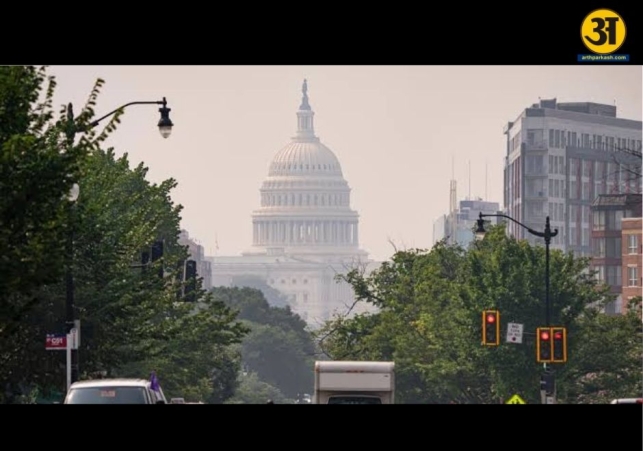
Wildfire smoke sparks fresh US-Canada tensions
Trump threatens tariffs on Canada as wildfire smoke worsens air quality across the US
A fresh dispute has emerged between the United States and Canada after US President Donald Trump threatened to impose additional tariffs on Canada over the growing impact of wildfire smoke drifting across the border. Trump accused Canada of failing to manage its forests properly and said the smoke from hundreds of wildfires has caused serious air pollution in several American states.
The comments come as Canada battles one of its most severe wildfire seasons in recent years. Thick smoke from the fires has spread across large parts of North America, affecting air quality for millions of people in both Canada and the United States.
In a post shared on Truth Social on July 17, Trump criticised Canada for what he described as poor forest management and claimed that polluted air from the wildfires was creating health and economic problems for Americans.
"The United States is being unnecessarily invaded by filthy, polluted, and unhealthy air," Trump wrote, adding that the situation was dangerous and unacceptable.
The US President also indicated that he plans to speak with Canadian Prime Minister Mark Carney about the issue and seek answers on what steps Canada intends to take to address the recurring wildfire smoke problem.
Trump argued that the smoke has become an annual challenge for the United States and has caused billions of dollars in economic losses. He suggested that these costs should be factored into tariffs currently imposed on Canadian goods, raising the possibility of new trade tensions between the two neighbouring countries.
Smoke from wildfires affects millions
Canada is currently dealing with a massive wildfire crisis. According to Canadian authorities, more than 900 wildfires are active across the country, with approximately 120 of them considered out of control.
Several of these fires are burning near regions close to the US border, including areas near Washington state, Minnesota, Michigan and Maine. Ontario has been among the hardest-hit provinces, with widespread evacuations ordered in some communities and numerous homes facing threats from advancing flames.
ALSO READ: Iran claims it destroyed US aircraft in Jordan after deadly American strikes in Iran
ALSO READ: Trump imposes 25% tariff on some Brazilian imports after trade investigation
The smoke generated by these fires has travelled hundreds of kilometres, crossing into the United States and affecting air quality in many major cities and towns.
Over the past several days, states stretching from Minnesota to New York have reported unhealthy levels of air pollution. In some areas, air quality readings have reached levels considered hazardous for sensitive groups, including children, older adults and people with respiratory conditions.
Health officials have repeatedly advised residents to limit outdoor activities when air quality levels become dangerous. Exposure to wildfire smoke can cause coughing, throat irritation, breathing difficulties and worsening of existing heart and lung conditions.
Meteorologists say the situation has drawn comparisons to the severe wildfire smoke event of 2023, when fires in Quebec caused days of poor air quality across large parts of the northeastern United States.
According to AccuWeather Vice President of Forecast Operations Dan DePodwin, the current wildfire season has the potential to create similar conditions in some regions.
Large smoke clouds continue to move across parts of Canada and the United States, depending on wind patterns and weather conditions. Air quality alerts have already been issued for millions of people across several states, including Delaware, Maryland, Michigan, New Jersey, Ohio, Pennsylvania and Wisconsin.
Experts say many of the current wildfires, particularly those burning in western Ontario, may have been started by lightning strikes. Dry conditions and strong winds have further contributed to the rapid spread of the fires.
Canada responds to criticism
So far, the Canadian government has not directly responded to Trump's threat of imposing tariffs or his criticism of Canada's forest management practices.
However, Prime Minister Mark Carney recently addressed concerns related to the wildfires and climate change. Speaking to reporters on July 16, Carney emphasised that climate change is a shared challenge that affects multiple countries, including both Canada and the United States.
His comments came after four Republican lawmakers from Michigan sent a letter expressing concerns about the impact of Canadian wildfire smoke on American communities.
The lawmakers argued that residents in their state have repeatedly suffered from poor air quality linked to Canadian wildfires. They said hospitals have treated children, elderly residents and patients with existing health conditions for smoke-related illnesses.
The letter claimed that this was the third consecutive year lawmakers had raised concerns with Canadian officials regarding wildfire smoke and urged stronger action to reduce the problem.
The issue has highlighted growing concerns about the increasing frequency and intensity of wildfires across North America. Scientists have repeatedly warned that rising temperatures, prolonged droughts and changing weather patterns linked to climate change are creating conditions that make large wildfires more likely.
While forest management practices play a role in reducing wildfire risks, experts note that climate-related factors have significantly contributed to longer and more destructive fire seasons in recent years.
The current wildfire season has once again demonstrated how environmental events can have cross-border consequences. Smoke does not recognise national boundaries, and its effects can be felt far away from the actual fire zones.
Trump's suggestion that tariffs could be linked to wildfire smoke introduces a new dimension to an already complex issue. Traditionally, tariffs are used as economic tools to address trade disputes, making the proposal unusual in the context of environmental and public health concerns.
Whether the tariff threat leads to any concrete action remains unclear. However, the comments have added a political element to a crisis that is already affecting millions of people across North America.
As firefighters continue battling hundreds of active blazes and weather conditions remain challenging, both countries face the immediate task of protecting public health and containing the fires. At the same time, the debate over wildfire management, climate change and cross-border environmental impacts is likely to continue long after the smoke clears.
Related News